
A recent national survey has raised alarm about indoor air quality across Canada. According to new data, over 10 million Canadians are living in homes where radon gas concentrations exceed recommended safety levels. Because radon is invisible and has no smell, many people have no idea whether their home has high levels. Testing and mitigation are essential to protect long-term health.
What Radon Is and Why It Matters
Radon is a naturally occurring radioactive gas that forms when uranium in soil and rocks breaks down. It can seep into buildings through small openings in foundations, gaps around pipes, and cracks in floors. When radon accumulates indoors, it can reach levels that pose health risks.
Health authorities advise action when radon levels reach 200 becquerels per cubic metre (Bq/m³) — a level associated with increased lung cancer risk.
Radon exposure is the second leading cause of lung cancer in Canada, after smoking. It is especially significant for people who have never smoked, making widespread home testing and mitigation critical.
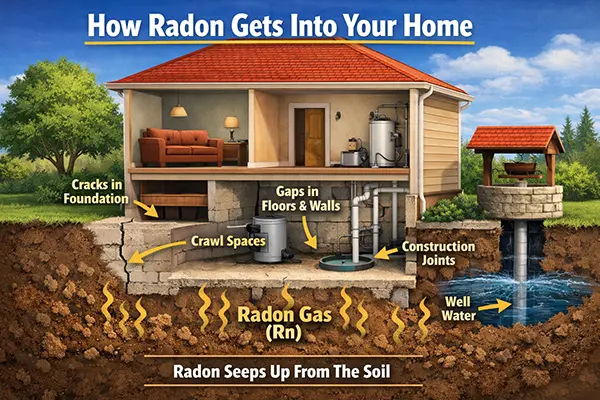
Key Findings from the Latest National Report
The 2024 Cross-Canada Survey of Radon Exposure involved tens of thousands of long-term measurements nationwide and produced two striking findings:
- Nearly 18% of Canadian homes have radon levels at or above 200 Bq/m³.
- This implies that more than 10 million Canadians live in homes with elevated radon, significantly increasing their lifetime lung cancer risk.
This proportion is more than double what was previously estimated. Radon levels vary by region, but no area in Canada is completely free of the risk.
Health Impact of Radon Exposure
Radon gas becomes dangerous when inhaled over long periods. Its radioactive particles can damage lung tissue, increasing the risk of lung cancer. Studies show that:
- Even at moderate levels, prolonged radon exposure raises lifetime lung cancer risk.
- Radon exposure causes thousands of cancer deaths each year in Canada.
This makes understanding and managing radon in homes an important part of preventing avoidable illness.
What Homeowners Should Do
Because radon cannot be detected without testing, every home should be checked:
- Conduct a long-term test (ideally 3 months or more) using a recognized radon test kit.
- Compare results to Health Canada’s guideline (200 Bq/m³).
- If levels are high, install a mitigation system such as active sub-slab depressurization. This can reduce indoor radon by 80% or more.
Testing kits and professional services are widely available, and long-term testing provides the most accurate indication of exposure risk.
Radon and Property Responsibility
For landlords, property managers, and condo boards, radon safety is increasingly relevant. While Canadian radon regulations vary by province, responsible property stewardship includes testing indoor air quality and acting to protect occupants. Proactive radon mitigation can improve health outcomes and help avoid future liability.
Final Thoughts
The evidence is clear: radon exposure in Canadian homes is not rare, and it carries real health consequences. With millions of Canadians potentially affected, testing and mitigation should become routine parts of home maintenance.
Radon is measurable and manageable — but action starts with awareness and testing. No home should be left unchecked.
物业智库
物业智库是 Xtends 的资源平台,专注于租赁管理策略、多伦多及安省市场动态,以及实用物业管理指引。我们分享社区发展趋势、租务部署建议、业主法规责任,以及公寓、柏文与独立屋的维护与管理最佳实践。内容专为大多伦多地区的业主与地产代理而设,提供及时且专业的资讯,协助确保合规经营、保障资产价值,并提升长远房地产投资回报。